Showing posts with label triumph. Show all posts
Showing posts with label triumph. Show all posts
Thursday, April 16, 2015

Saturday, September 27, 2014
Car of the month Sept 2014 - Triumph Stag

In 1970, Triumph gave the sporting family man the chance to feel the wind in what was left of his hair while his kids created havoc on the back seats. The Michelotti-designed car was equipped with a 3.0-litre V8 engine that developed a reputation for unreliability, with some owners resorting to fitting a Rover V8 unit in its place.
This conversion is now frowned upon, and to get yourself accepted in Stag circles you'll need an original-engined car rather like this one at Spring Garage, in Leicestershire.
With two owners from new and just under 46,000 miles on the clock, this car looks great and drives brilliantly. The recent respray was carried out when the Carmine Red paint faded, but the panels beneath are original and unwelded.
Inside, the brown vinyl seats and trim are excellent and the multitude of dials and switches work as they should. Of particular interest here, given the engine's notorious reputation for overheating, is the temperature gauge - which remains steady in all driving conditions.
- Ben Field
Envisioned as a luxury sports car, the Triumph Stag was designed to compete directly with the Mercedes-Benz SL class models. All Stags were four-seater convertible coupés, but for structural rigidity – and to meet new American rollover standards of the time – the Stag required a B-pillar "roll bar" hoop connected to the windscreen frame by a T-bar. A removable hardtop was a popular factory option for the early Stags, and was later supplied as a standard fitment.
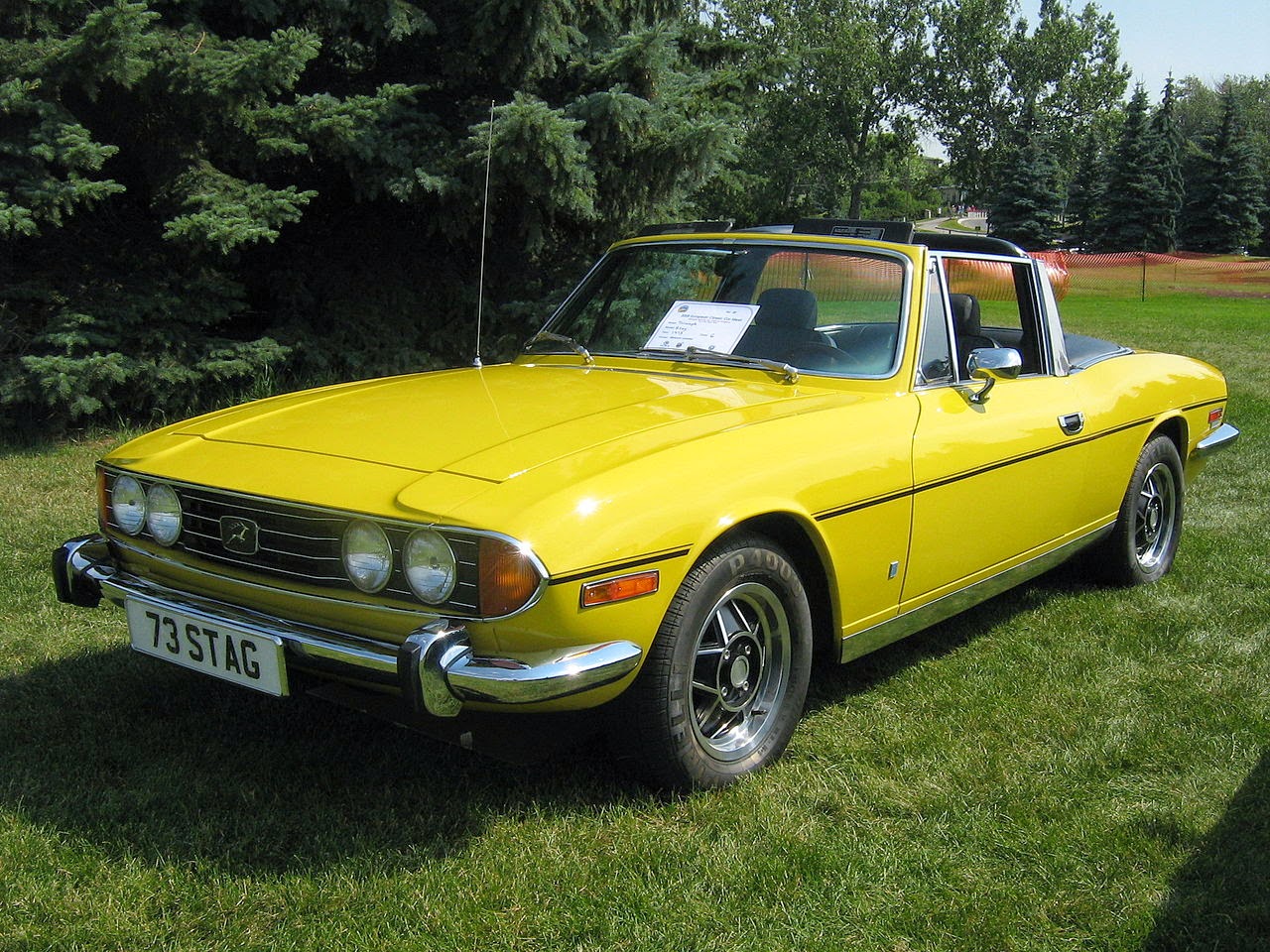
Envisioned as a luxury sports car, the Triumph Stag was designed to compete directly with the Mercedes-Benz SL class models. All Stags were four-seater convertible coupés, but for structural rigidity – and to meet new American rollover standards of the time – the Stag required a B-pillar "roll bar" hoop connected to the windscreen frame by a T-bar. A removable hardtop was a popular factory option for the early Stags, and was later supplied as a standard fitment.
Pic from Wikipedia
PERFORMANCE
Automatic gearbox mutes of-the-line acceleration, but torguey engine delivers plenty of mid-range power once on the move.
HANDLING
Comfortable ride. A little body roll in the corners, but this is more of a tourerthan an out-and-out performance vehicle. Brakes a bit spongy.
ENGINE
Runs smoothly. Oil pressure correct at 45psi. Coolant temperature keeps steady.
TRANSMISSION
Flawless automatic changes enhance the Stag's smooth cruising nature.
STRUCTURE
No welding torch has ever been near this car. Floor pans still have original factory paint on them. Very solid indeed.
BODYWORK
The recent resp0ray is of a very high standard. No signs anywhere of bubbling suggests that the new paint isn't covering up rust.
EXTERIOR TRIM
Chrome work is complete and in very good order. Original wheels have never been kerbed.
INTERIOR
Trim is excellent throughout. All electrical items, including windows, are fully functional.
HISTORY
Service history and many bills from new, including original bill of sale. Thick bundle of MoTs help to verify mileage.
VERDICT
A great example of this popular sports tourer.
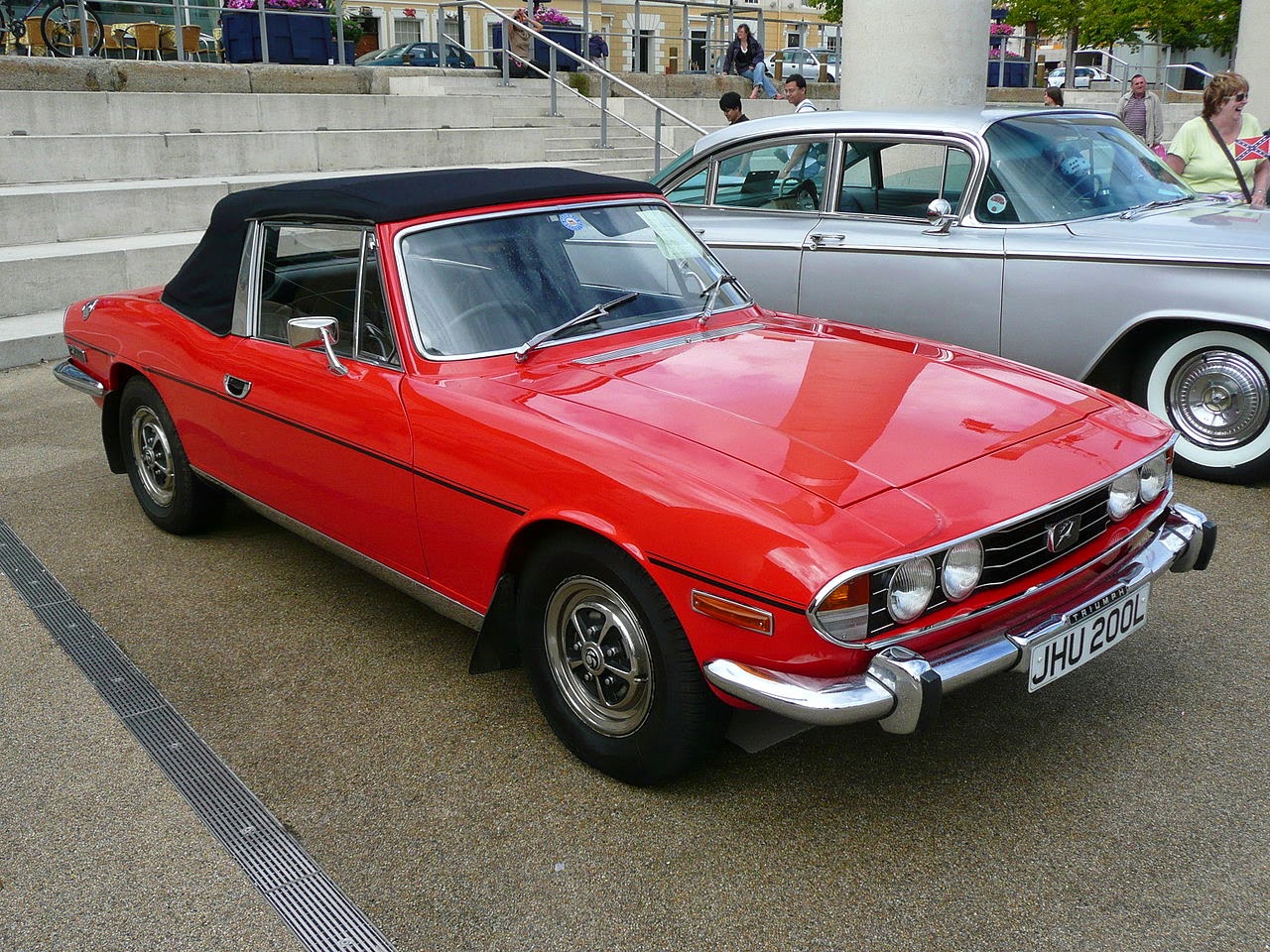
1972 Stage - pic from Wikipedia
::
Thursday, June 12, 2014
Car of the Month May 2014 - Triumph Spitfire (1962-80)

Triumph's Spitfire is affordable, pretty, simple and fun, so it doesn't need
to be a road-burner appeal. It can be bought and run cheaply, up-rated
easily and give excellent service.
On sale for almost 20 years, the Spitfire was conceived by Triumph in 1957 as a response to the market for Ford side valve specials and cars like the Standard Ten-based Fairthorpe. BMC brought out the Austin Healey Sprite and MG Midget, but Triumph's foray was delayed by development costs, finally arriving in 1962 with an uprated version of the Herald 1200's 1147cc engine.
The pretty and practical Spitfire offered a decent-sized boot, wind-up windows and a more spacious interior than a Midget. It was one of the most successful shapes from Italian stylist Giovanni Michelotti.
Making use of mainstream Herald componentry, it boasted independent rear suspension and a tiny turning circle. It had a better ride than other small sports cars and, although criticised for a tendency to 'jack up' if the driver lifted mid-corner, it only let go if driven hard. the problem was eradicated with the s[ring spring set-up fitted to MkIV's in 1070, which can be fitted to earlier cars.

Pretty and practical, but the Spitfire can rust in many areas.
Trim is simple and widely available.
Spitfires are great fun on a sunny day and civilised enough in bad weather, especially with the optional hardtop. MkI's am II's are the cutest, MkIII's the most turnable, MkIV's the cheapest and lat 1500's the most practical.
Spitfires out-sold Spridgets throughout and more than 300,000 were built. They were rallied and raced at Le Mans, spawning the fastback GT6. Triumph never built an open GT6, but many have been converted. If a Spitfire body is fitted to a complete GT6 chassis/running gear, the conversion is successful - fitting GT6 running gear to a Spitfire rarely works as so much must be changed.
Many more Spitfires were sold in the US than the UK, but very few have come back. Emissions equipment took the MkIV 1300 down to 48bhp and US cars used the 1500 engine from 1973.
BODY/CHASSIS
For a restoration project, you should walk away from a car that needs major body work. It costs too much to do it properly. The sills are key to a good restoration, and they are key to a good Spitfire purchase. The sills are structural and are critical to good door fit and consequently also affects the fit of the hood.
Spitfires can rust in many areas, but thankfully most of it is easy to find because of the way these cars are built. Door bottoms rust, as do rear wheel arches as well as the valance below the rear bumper. The optional hard-top is a desirable extra, but check that all fittings are present and look for rust along the front edge and below the windows, especially on MkIV's. The Spitfire chassis rarely suffers any rust, but should still be checked.

ENGINE
The worst engine is the MkIV 1300, though its cylinder head has better porting and bigger valves than the MkIII, which is easily swapped over.
Despite starting life in 1953 with 803cc, the four-cylinder Spitfire engine is robust and dependable. Spitfires never had an oil pressure gauge as standard. If one is fitted, expect 60-75psi at speed when cold, dropping to 40psi when thoroughly hot. A good blast on a motorway is needed before the pressure on a worn engine will drop to around 25psi at speed.
TRANSMISSION
Marks I-III used a three-rail gearbox with synchromesh on the top three gears and optional overdrive; the MkIV added synchro on first (and stronger overdrive in 1974), while the 1500 had a stronger single-rail gearbox (with four synchros and optional overdrive).
Mks I-III used a 4.11:1 Herald-spec differential; MkIV used the 3.89:1 larger flange diff developed for the Vitesse 2-litre, while the 1500 went to 3.7:1.
SUSPENSION
Spitfire suspension is simple and reliable if well maintained, but needs regular attention. You cannot over-lubricate them and neglect leads to rust forming at the top of the thread on the vertical link.

Scruffy interior is inexpensive to refurbish.
INTERIOR TRIM
Spitfire trim is simple and virtually all available. It's vinyl on early cars (with extremely rare leather option), but seats acquired hounds tooth cloth centre panels on 1500's from FH100020. Hoods made on the original tooling are still available for MkIV on, ut Mks I-III hoods vary in quality.
SPITFIRE MKIII 1969
ENGINE : 1296cc four-cylinder OH valves Twin SU carbs
POWER & TORQUE : 75bhp @ 6000rpm
TRANSMISSION : Four-speed manual, optional overdrive, rear-wheel drive
PERFORMANCE : Top speed 95mph, 0-60mph - 12.5sec
WHICH IS WHICH?
SPITFIRE 4
1962-64 - Original 63bhp gave 92mph, with 5.20x13 crossply tyres on 3.5in disc wheels. From 1964 optional 4.5in wires, overdrive and hardtop.
SPITFIRE 4 MKII
1964-67 - Carpets replace rubber mats, vinyl trim over metal dash, power up to 67bhp, with new camshaft and tubular exhaust manifold.
SPITFIRE MKIII
1967-70 - Re-designed for US bumper legislation: 9in higher in front bumper, one-piece folding hood, wire-spoke Vitesse/TR4 steering wheel, wood-veneer centre dash panel, 1296cc eight-port engine giving 75bhp.
SPITFIRE MKIV
1970-74 - Major re-design by Michelotti cleaned up body styling and modernised interior. Hardtop also re-designed. All synchro gearbox and alternator standard.
SPITFIRE 1500
1974-80 - 1493cc long-stroke engine with 2.5in SU carbs gave 71bhp. Stronger single-rail gearbox plus higher final drive.

Info from 'the World Encyclopedia of Cars' - Martin Buckley and Chris Rees
.
Subscribe to:
Posts (Atom)


