You ever wonder what's the deal with those guys that run old slow cars around the track at "vintage races" when there's so many modern, quick options? I mean, a Miata smokes almost everyone of those old sport cars, right? Why would you ever waste money running something old and slow?!
At the last Portland Historic Races it struck me how few people were in the stands. Our culture has no understanding of how exciting these vintage sport cars are, as well as the times and history they represent.
I've thrown this blog together as a primer. I think that if I could share with you some of the stories I (think I) know, you might gain a fresh appreciation for vintage sport car racing. And if you're one of my friends, maybe you won't think I'm so weird/nerdy/etc. for spending time and money on my 1957 sports car!
And for your sake I'm going to greatly abrige this and only hit you with the highs. Although I do have pictures in my stock of quite a few of these subjects, I've decided to use period photos available from the internet because, well, they're better. If someone owns these photos and wants me to take them down, I will. I understand all of these pieces to be free to use because they are freely available online. I make no money on this blog, it is a hobby.
I might get a few things wrong or slightly off because I until someone pays me to do this I just don't have time to research and write a novel titled "The History of Racing". Someone else has anyways. And it's awesome. If you only have 20 minutes, read this blog. After you read this blog and realize how awesome vintage racing is, or if you have 5 hours to invest, you should watch the Shell series The History of Racing available on YouTube.
If you don't have time for Shell, well then read on.
Photo from first car race
What's considered the first car race occurred in 1894 in France. The 1st across the line was a gentleman named de Dion but he was disqualified because his car was more of a train, running on steam using a stoker system. Second across the line was a Peugeot. This might be the last race that a Peugeot won. Somewhat fitting for a car made in France, who also have not won a war of their own accord since the 1800s.
I'm kidding, Peugeot made some great racing cars during these early years and even won the Indy 500 state side.
De Dion is a well known name in car circles because shortly thereafter he designed an axle that allows each wheel to move up and down independently. It was largely ignored and cars typically had solid rear axles. 60 Years later Jaguar adapted this De Dion rear end into their E Type sports car. Since then all sports cars have went that direction in some form, the last holdout being the Ford Mustang, who have just announced that in 2015 they will finally get an independent rear end... 115 years after Mr. de Dion invented it. Way to adapt quickly Ford!
France continued to be the leader in car racing. England instituted some weird laws due to public concern about cars and horses. You could have a car, but you had to hire someone to walk in front of you with a flag. No wonder Mr. Toad craved speed, he was stifled by British law!
1903 Paris-Madrid
Scarcely 9 years later cars had come a long way. See the above photo taken during the Paris-Madrid race. Instead of rudders, some cars had steering wheels, and the overall shape was beginning to resemble less a "horseless carriage" and more our traditional car.
Unfortunately safety had not progressed along with the car. Tires were still solid, suspension almost non-existent, brakes minimal, center-of-gravity high, etc. The Paris-Madrid of 1903 is actually France's last open-road race. In the passenger/mechanic seat of the above car, which was leading the race is one of the Renault brothers. After the first day of racing French government stepped in and stopped the race after nine fatalities, including the brother of Mr. Renault who was following behind in another racer.
On the American side of the pond, oval racing became popular. This author's opinion is that this may have stemmed from the velodromes that were common to bicycle racing prior to the cars takeoff. As oval racing is a far cry from open-road, sport car racing, other than this mention this blog will stay away from the rich history of oval racing.
The above is a picture of Eddie Rickenbacker, one of the famous pre-WW1 American racing heroes. His autobiography is a must have. His father died when he was 8. Eddie went to work at a local factory to help support his family (he was the oldest child). While working at the factory he took by-mail engineering courses. His engineering background gave him an opportunity at an auto-shop. The shop sponsored race cars and Eddie was given the opportunity to drive. He became an American racing hero due to his success, nicknamed "Fast Eddie".
At the outbreak of WW1, Eddie was technically too old to become a pilot. So he travelled to France and showed up at the base of the Hat-in-the-Ring flying squadron. In an odd coincident, he had previously helped the base commander fix his car back in the states. The base commander let Rickenbacker learn to fly.
By the end of the war Eddie was America's leading Ace and the leader of the Hat-in-the-Ring squadron.
Eddie went on to own the Indianapolis Speedway, and Eastern Air Lines. In addition, he was a WW2 spy to Russia because Russia wanted his advice on their planes. Rickenbacker crashed at sea in a B-17, surviving with his crew on a floating raft for close to a month. A Christian, he had a small bible in his suit and Eddie instituted daily bible studies on the raft. The experience brought several of his co-raftees to believe.
His autobiography includes some prototype testing he was involved with, including a photo of a rocket powered pack the pilot would wear.
Eddie's life reads like a science-fiction, adventure fiction story. Then you read who endorses the book. Jimmy Doolittle and a President. No fiction here.
Fast Eddie was a model American, through and through.
In 1907 England opened the 1st purpose built racetrack, Brooklands. Built with steep banking, the intent was that cars that drove near the top would need to turn little or at all on the banking. The track was fast but bumpy. The sectional concrete paving technique was the cause of the bumpy ride. Brooklands stayed a track until WW2, although as speed increased it wasn't uncommon for Brooklands to send cars airborne.
During WW2 Brooklands was used for a airstrip and parts of the track were destroyed during bombing raids, or taken out for facilities.
James May, of Top Gear fame, recreated the Brooklands track using the local community and Scalextric race cars and track. It's a fun watch -
But we're getting ahead of ourselves. Let's rewind back.
WW1 put a pause to motor racing. The world was involved in one of it's most deadly and brutal struggles. 16 million men died, and 20 million were injured.
After WW1 the world slowly recovered and again men set their mind to finding ways to appease their desire for adventure.
It's important to keep in mind, these cars were far from docile. They had large iron motors that propelled the cars along at great speeds, but seldom had brakes to match the power of their momentum. In addition, there were little to no safety considerations. Videos of Brooklands racing are ripe with people flying off the top of the track. There was no seat belt or roll bar, so the drivers best hope was to be thrown clear of the machine. The tiny windscreens provided little protection and it was common for drivers to have rocks and birds hit them in the face at 100+ mph, including one of the Le Mans winning Bentley drivers (who, coincidentally, had been refreshing himself with Cognac during pit stops).
It was at this time Bentley established their reputation.
From 1924 to 1930 Bentleys won 5 of the Le Mans races, an epic 24 hour race on a road circuit in France. Obviously the course was closed to traffic, based on the 1903 rules, but some of the locals still didn't recognize the closure of the road for the race. One of the old ladies that lived along the route was famous for walking across the track in indifference to the race in order to visit with her neighbors.
Almost equally as dominating as the Bentleys at Le Mans was the Type 35 Bugatti in the World Championship races. Statistically the Type 35 has over 1000 registered wins. It was a dominating Grand Prix race car and in 1926 took the world championship.
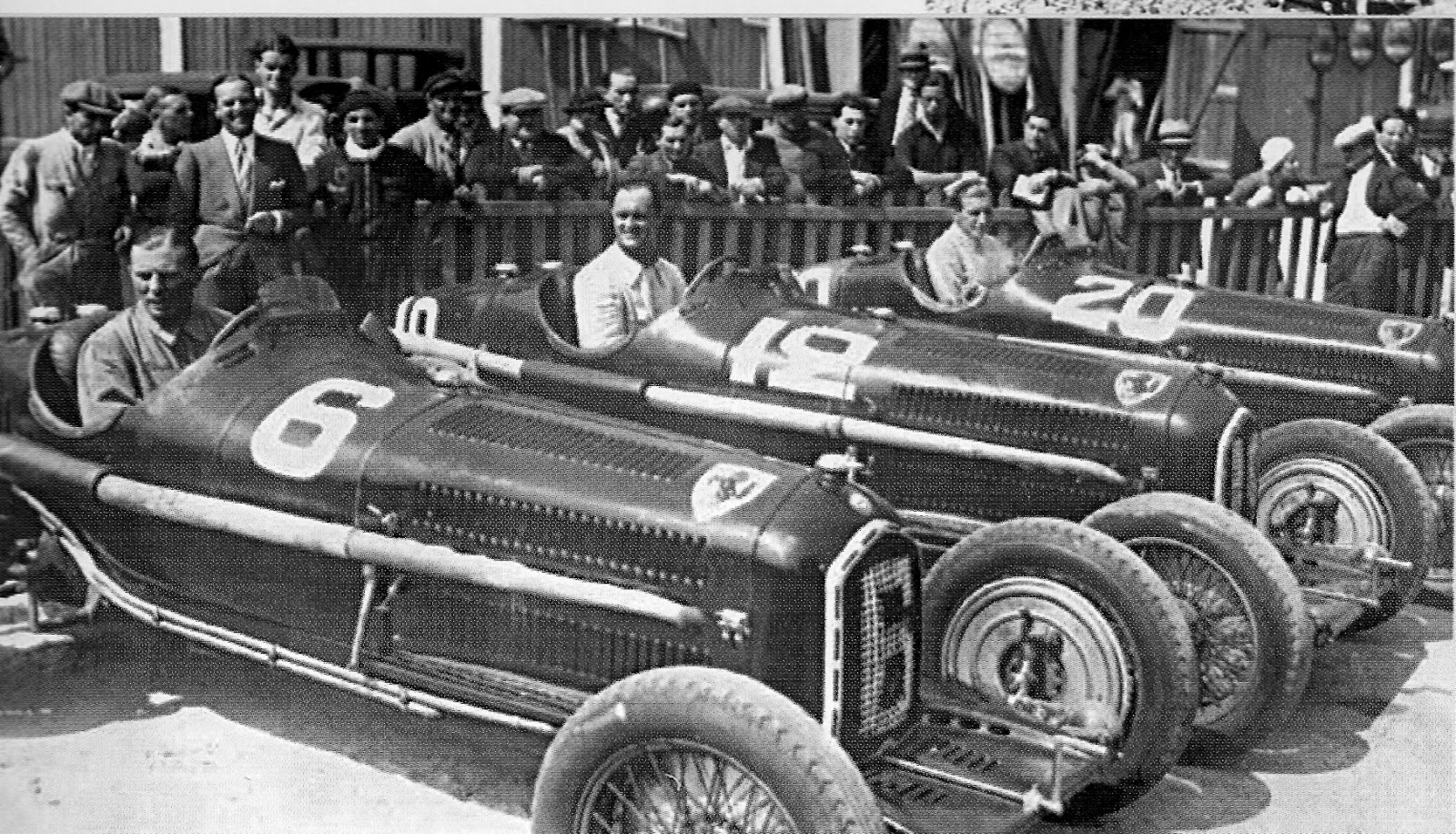
Another period contender for top dog was Alfa Romeo. In 1925 Alf Romeo introduced their straight 8 motor and won the first ever world championship series. One of Alfa's top aces was Nuvolari.
This straight 8 Alfa design continued on through the early 30s. Alfa vied with Bugatti, Delage (French), Mercedes, and Bentley for the supremacy.
National pride was endowed to each of these manufacturers. The whole country followed the races to see if their countries car would win the world championship.
It was at this time that a former racer, Enzo Ferrari, took on management of the Alfa Romeo team. A WW1 veteran, he was approached by the family of a famous WW1 Italian ace, who requested that their sons family crest be applied to the Italian Alfa racing cars as a good luck symbol easily identifiable to Italians. Ferrari agreed and thus was established possibly the most famous automotive symbol, the prancing horse later to be used as Ferrari's emblem. Not many people know that the Alfa Romeo team originally wore the prancing horse.
In 1933 Adolf Hitler, and the Nazi party, came to power in Germany. The Nazi's were set on making the other nations recognize their supremacy in all things, including motor racing. The Nazis funneled money into race car development and the Mercedes race cars leaped in technological innovation. The W25 Mercedes replaced Mercedes outdated SSK (designed by one Ferdinand Porsche). The motor in the W25 would eventually reach near 500 hp.
Now the Mercedes and the Audis of this period can barely be considered sports cars, but the Alfas, Bentleys and Bugattis they were racing again are seen on the road to this day, so by default we'll lump them in with sports cars. In truth though, these were probably the first cars that could be considered pure race car.
It was at this time that the previously mentioned Nuvolari made what may be the greatest victory of all time.
The Nazi party had been pouring money into the Mercedes and Audi teams (we'll discuss Audi in a minute). They also poured money into their tracks.
In 1935, at Germany's famous Nurbergring, in front of the leading members of the Nazi party, driving an outdated Alfa Romeo, Nuvolari defeated the German cars and took the checkered flag. Beyond being an unbelievable drive, it was a slap in the face for the domineering, brooding, fearsome Nazi party. This may be one of the greatest under-dog stories of all time.
We haven't talked about the fearsome Auto Union Type D yet, but it deserves equal mention. It's said that few men could drive this rear engined monstrosity. The Auto Union and the Mercedes were dubbed the "silver arrows".
Hans Stuck is its most notable Type D driver. His epic charge of the Austrian Glossglockner is still talked about, Classic and Sports Car magazine recently taking an Auto Union Type D out to the mountain to recreate the experience. So successful was Stuck and the Type D at hill climbs, Stuck was nicknamed, "the king of the mountains" in German. Stuck's last hill climb championship was at age 60 when he was the German hill climb champ.
Glossglockner
The Mercedes Silver Arrows also showed strong showings at Glossglockner.
The Germans touted their race cars as a matter of Nazi pride.
In 1937 the Germans improved their track at Avus with an extremely banked corner so their cars could maintain speed through the corner demonstrating how fast they truly were at nearly 500 hp.
Because Avis wasn't on the World Championship circuit, streamlined bodies were allowed. Mercedes and Auto Union created two of the most beautiful pre-war cars ever made for this race, but yet beyond their smooth lines their stark metal bodies and nazi emblems dripped with an ominous overtone.
Ironically, in one of the more famous shots of the Avus banking at the 1937 race the American flag flies in the corner.
But half a world away, another star was coming into his own. The year was 1938 and Juan Fangio started racing in Argentina with a beat up Ford V8. Fangio was 28.
By 1940, in a Chevy, Fangio had become Argentina's champion.
After the war Fangio began racing in Europe.
He won, and won, and won. His nickname became "El Maestro". He won 5 world championships, the last in 1957 at the age of 47 years old. He retired in 1958. He won 24 of 52 formula one races.
Fangio went to whatever team he thought he'd have the most success with. In the 50s he bounced around Alfa Romeo, Mercedes, Ferrari and Maserati.
If you'd like to see the Maestro at work, there's a great video on Youtube of the 1955 Belgium Grand Prix in which he destroys his competitors. It isn't even a race.
Days after the Belgian Grand Prix, the worst tragedy in all of racing history occurred, and Fangio drove through it. At Le Mans a pitting car forced another car to swerve around it. The Mercedes car following the swerving car hit the rear fender and was directed airborne into the crowd. 83 spectators, and the driver were killed. At the end of the 1955 world championship, Mercedes withdrew from racing until the 1980s.
You'll note that Fangio drove through the accident
I wish the 1955 Le Mans were a happier note, as my car made it's racing debut there.
If you watch the 1955 Belgium race you'll note that Fangio's teammate, Stirling Moss, also dominates the rest of the pack. That same year Moss beat the Italians on their own roads at the most famous road race still in existance, the Mille Miglia (Thousand Miles). Moss' performance, both Grand Prix and road racing/rallying, led many to believe he would be the next great. Unfortunately a terrible accident in 1961 ended his career. He continues to this day to be a great advocate of vintage car racing. The British have knighted him and regard him as a national hero.
In a video on Youtube, the famous actor Patrick Steward takes lessons from Moss in an effort to emulate him. It's a great watch.
Across the pond, over here in America, the introduction of the Corvette and T-bird had ignited a road racing passion. Road racing became trendy with the youth and road races were packed with young men wanting to try their machines, and the stands were filled with the girls and families that had come to watch. Adding also to the passion were the WW2 veterans, who had seen the european sport cars during their deployment and desired them.
One of the most famous of these racers was one Carroll Shelby. A (failed) chicken farmer from Texas, he became a diplomat to the European racing circuits when his fast racing won him a seat on the World Championship circuit.
Carroll wanted to stay true to his roots and he'd often wear overalls and a cowboy hat at the races.
In 1959 Carroll and a teammate won Le Mans. It was the first time an American had ever won Le Mans.
A heart condition caused Mr Shelby to retire after the Le Mans victory but he would be back in a prominent way in the history of road racing.
Also of note, one of the most successful women drivers appeared on the scene in the late 50's, and she was the sister of none other than Stirling Moss.
Pat Moss out and out beat everyone (men included) in the 1960 Leige-Rome-Leige rally. Moss continued to be a prominent player in rally racing well into the 60s, including an important early win for the mini Cooper at the 1962 Tulip Rally.
The Mini Cooper. Specifically in "S" spec, challenged everything anyone believed. It's light weight, peppy motor, affordable cost, low center of gravity, incredible handling and ease to maintain led to many successes over much bigger, faster cars. It won the Monte Carlo rally outright three times. The Mini Cooper S was nicknamed "the Giant Killer".
Remember old Carroll Shelby? Well, around this time he got it in his head that what the world needed was a car with European handling but American muscle. Many of the British sport cars had little 4 or 6 cylinders, while the Corvettes touted V8s.
Shelby talked Ford into providing motors, and AC into providing a chasis, for an American powered sports car.
The Shelby Cobra was born.
Well, back when Carroll had been racing, Ferrari had extended a factory racing seat and when Carroll arrived in Italy, old man Ferrari reneged. Carroll now had a burning passion to beat Ferrari at sports car racing.
Plus, Carroll's blood pumped American. He wanted to see an American sports car win the world championship.
On the short courses his Cobra's blew the Ferrari's out of the water (once he'd figured out how to keep the axles together, the ACs not being up to the task). But unfortunately on the long tracks, the Cobra suffered from an aerodynamic problem; the Cobra wasn't aerodynamic.
Carroll and his team went to work on an aerodynamic coupe version of the Cobra. The Shelby Daytona was born. The Daytona won the World Championship in 1965, beating Ferrari.

Shelby then went to work with Ford on the GT40, which defeated Ferrari's 6 year winning streak at Le Mans in 1966.
Back on our side of the pond, Ford's partnership with Shelby led to some fast Mustangs produced with Shelby racing generated technology. The Camaro was pressed to keep up.
The Trans Am racing series pitted the two against each other. Whoever posted wins meant sales at the dealership on Monday.
Roger Penske, a famous ex-racer, partnered with Chevy to run the Camaro team. In 1967 the fledgling Camaro didn't show much promise, but Penske felt certain he could sort the car out.
And they famously cheated.
Chevy pressed thin steel for the '67 race car. When weighed after it's only 67 win, it was found to be 250 pounds lighter than the minimum weight. Trans Am only allowed the win to stay in place because Penske threatened that Chevy would back out of the Trans Am series. They did ban the car from racing in future years.
1967 Lightweight Camaro
For 1968 Penske acid dipped his cars. Then added the weight back in at key places that would keep the center of gravity low and aid handling. There's a story of someone leaning against the roof and causing a hand print in the thin metal.
Also, Penske again snuck the 67 lightweight car in to races. They switched out the grille and other items for a 68. Then they had a 68 car pass tech inspection. When the 68 got back to the pits, they'd throw the 67s stickers on the 68 and send it back to tech inspection. After the 68 passed a second time they'd slap the stickers back on the 67 and race the banned 1967 lightweight car.
The Penske team won 10 of 13 races in 1968, winning the Trans Am title.
They repeated the feat in 69, again winning the title.
After Trans Am, I can't think of any significant sports car racing. Sure, there's been more Le Mans races. And the Sports Car Club of America keeps on holding events. But there's no racing series with street drive-able sports cars that captivates the world with it's results. Race results don't make or break a car makers sales. Nations don't anxiously follow race results.
Those old cars you see going around the track at vintage races stand for so much more than car racing. National pride was at play when they raced. The men that raced them were giants of men, heroes to their nation and in some cases, the world. Nations watched those old cars race in awe. Auto makers watched the races knowing that the race results would make them or break them. Names like Bentley, Ferrari and Shelby were established by the results those old cars posted.
Modern cars can go around the track faster (in some cases) but the modern cars don't have the rich heritage of vintage race cars. That's why I choose to pursue vintage racing. In some way I want to associate with the rich history of these old cars. I want to see Nuvolari's car and imagine the Nazi's staring at it in hate. I want to see Fangio's car and imagine El Maestro. I want to race my MGA and imagine what a 1955 Le Mans (before the accident) must have been like. I'd like to build a Daytona replica and see just what it was that Shelby came up with for America.
It's vintage racing for me.



.jpg)


_9th.jpg)




.jpg)


